Sofia Hartmann · 19 September 2026
Tracing Porosity Control Methods for Weather-Resistant Sculptural Mediums
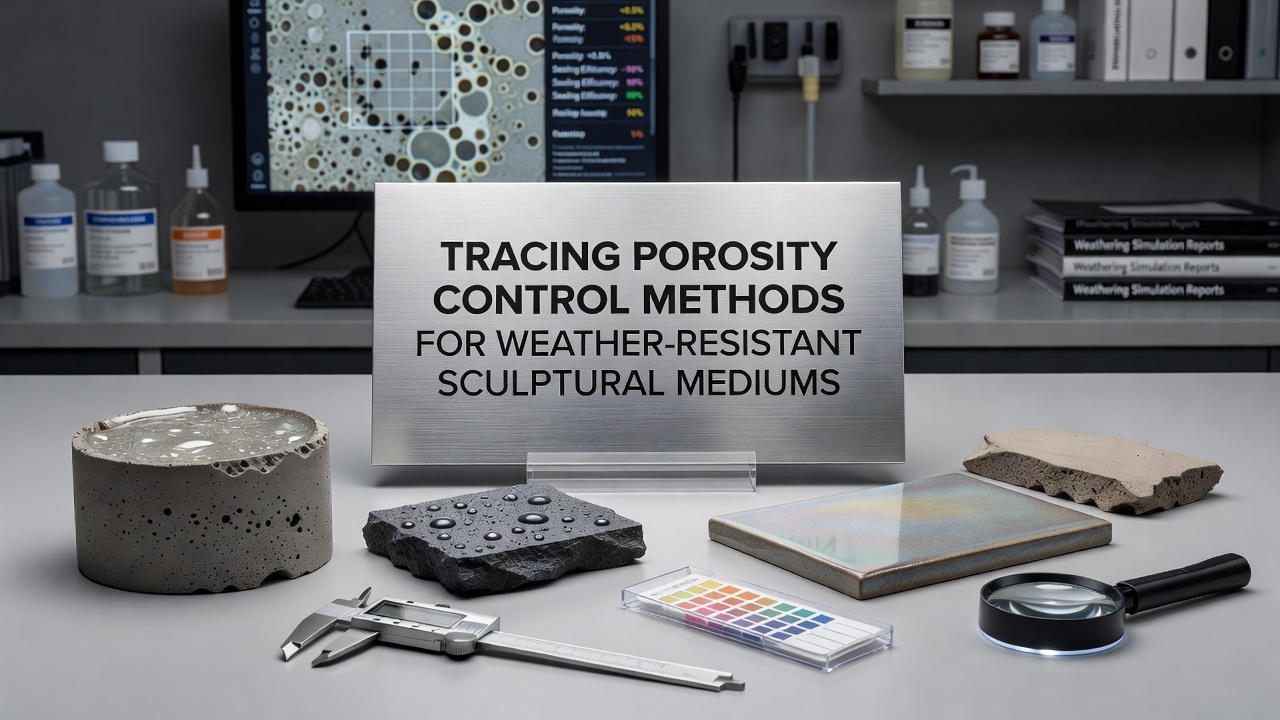
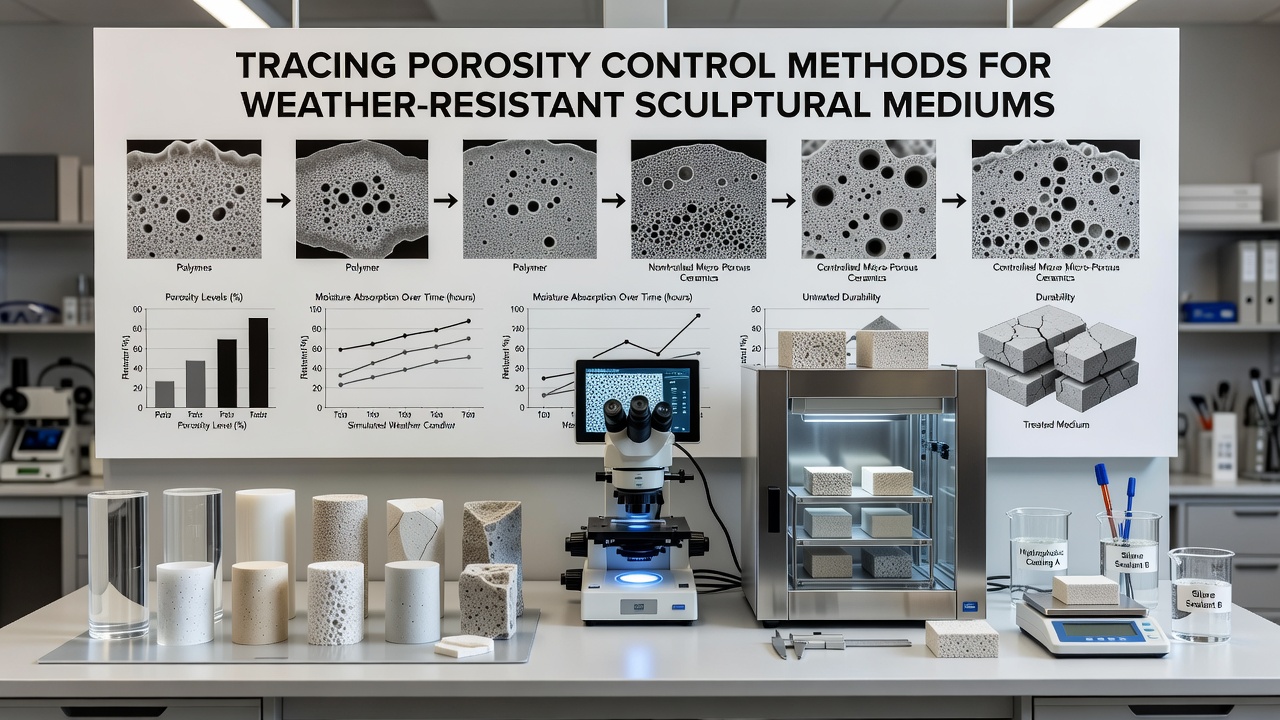
Porosity control in sculptural mediums such as clay composites, stone aggregates, and resin-infused matrices plays a central role in achieving long-term weather resistance, because open pore networks allow moisture infiltration that leads to cracking during freeze-thaw cycles, whereas reduced porosity limits water uptake and maintains structural integrity over decades of outdoor exposure. Researchers track these methods through laboratory testing that measures water absorption rates, mercury intrusion porosimetry, and accelerated weathering protocols standardized by organizations including the National Research Council Canada.
Understanding Porosity in Sculptural Materials
Porosity refers to the volume fraction of voids within a hardened medium, and in sculptural applications this property directly influences durability because interconnected pores create pathways for water, salts, and pollutants to penetrate the surface. Studies from materials laboratories show that mediums with porosity above 15 percent typically exhibit higher degradation rates in temperate climates, while those held below 8 percent demonstrate improved resistance when paired with surface treatments. Observers note that particle size distribution during mixing affects final pore size, with finer clays and fillers producing smaller, less connected voids that resist capillary action.
Compaction and Particle Engineering Techniques
Compaction methods reduce initial porosity by applying pressure during forming, and vacuum-assisted de-airing systems remove entrapped air before curing begins. Data from university-led trials indicate that vibration compaction combined with optimized aggregate gradation lowers total porosity by up to 30 percent compared with hand-built forms. Those who formulate sculptural mixes often adjust the ratio of coarse to fine particles so that smaller grains fill interstices between larger ones, creating a denser matrix without requiring excessive binder content that could introduce shrinkage cracks. In practice, this approach integrates well with stone-based mediums where marble dust or silica flour serves as the fine fraction.
Additive Strategies for Pore Sealing
Chemical additives such as pozzolanic materials and hydrophobic agents modify pore walls during curing, and acrylic emulsions or silane treatments applied after drying further decrease permeability. Research indicates that incorporating metakaolin at 10 to 15 percent by weight of cementitious binder refines capillary pores through secondary hydration reactions that fill voids over time. External sources like reports from the Australian Centre for Advanced Materials note similar outcomes when nano-silica particles are dispersed in the mix, because these particles nucleate additional hydration products that narrow pore entrances. Application occurs either during batching or as post-cure impregnation, and each route produces distinct pore size distributions that conservation scientists measure through nitrogen adsorption isotherms.
Thermal and Sintering Approaches
Firing or heat-curing schedules densify certain mediums by promoting sintering between particles, and controlled temperature ramps between 900 and 1100 degrees Celsius close open pores in clay-based sculptures without causing bloating. Evidence from European materials institutes shows that holding peak temperature for two hours followed by slow cooling yields porosity reductions of 40 to 50 percent in stoneware formulations. Those working with hybrid mediums sometimes combine low-temperature curing with microwave assistance to accelerate reaction kinetics while limiting thermal gradients that could reopen pores through differential expansion.
Coating and Impregnation Layers
Surface coatings provide an additional barrier, and multi-layer systems that alternate organic and inorganic films achieve synergistic sealing effects. Polyurethane topcoats paired with silicate primers reduce water uptake to less than 2 percent by mass in tested samples, according to figures released by conservation research groups. Impregnation with low-viscosity epoxy or acrylic resins penetrates residual pores under vacuum pressure, locking in place after polymerization and blocking further moisture movement. Application timing matters because coatings applied too early trap internal moisture that later expands and delaminates the film, whereas delayed application allows full curing of the substrate first.
Testing Protocols and Performance Data
Standardized tests quantify the success of each control method, and ASTM and ISO procedures measure capillary water absorption, vapor permeability, and salt crystallization resistance. Laboratories report that mediums treated with combined compaction and silane impregnation retain flexural strength above 80 percent of initial values after 100 freeze-thaw cycles, whereas untreated controls fall below 50 percent. A symposium scheduled for September 2026 will present updated field data from installations in coastal and alpine environments, allowing direct comparison of laboratory predictions against real-world weathering rates.
Conclusion
Tracing porosity control methods reveals a sequence of interconnected steps that together determine the weather performance of sculptural mediums, from initial particle selection through final surface treatment. Continued refinement of these techniques rests on precise measurement and iterative adjustment, supported by data from international research networks that track long-term outcomes across diverse climates and material systems.