Drew Klein · 17 October 2026
Analyzing How Particle Distribution Shapes Reflective Qualities in Hybrid Mineral Sculptures Under Gallery Lighting Conditions
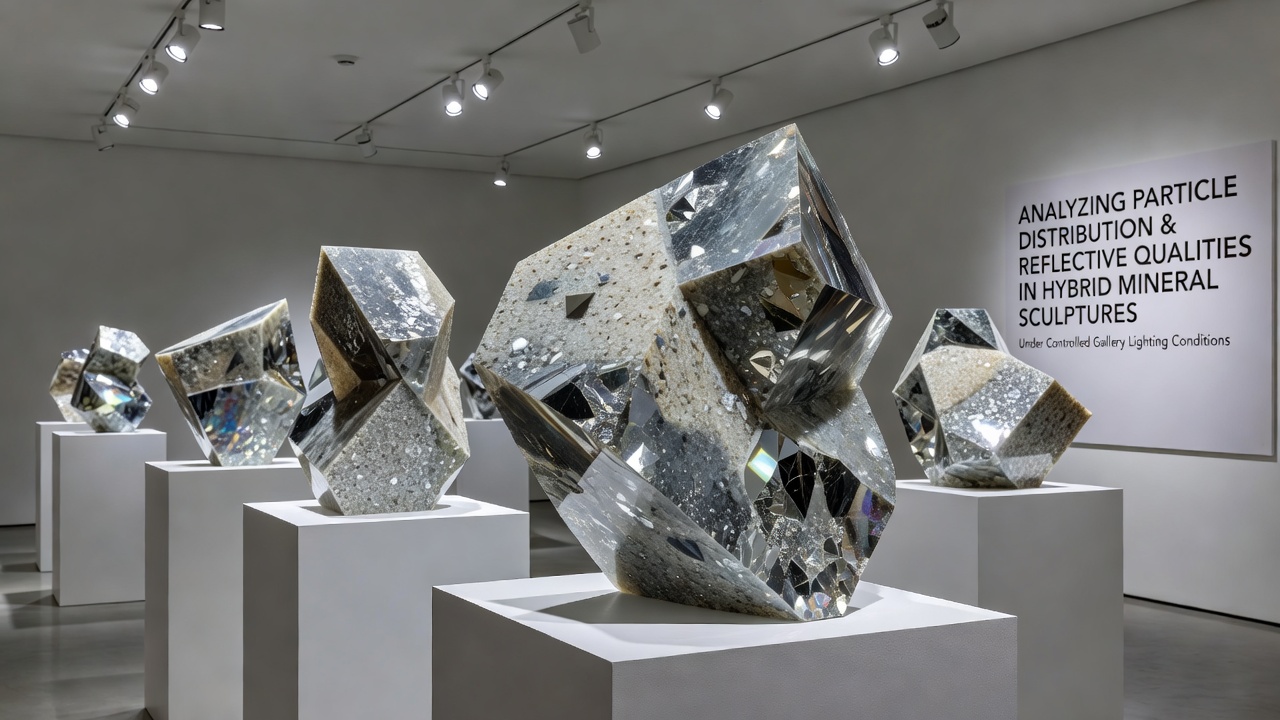
Particle distribution in hybrid mineral sculptures determines how light interacts with surfaces composed of blended mineral components such as quartz aggregates mixed with resin-bound feldspar or calcite matrices, and researchers have documented these effects through controlled experiments that measure specular and diffuse reflection coefficients across visible wavelengths. Gallery lighting conditions typically involve LED arrays tuned to 3000K to 4000K color temperatures with beam angles between 15 and 45 degrees, which accentuate differences in surface scattering when particle sizes range from submicron dust to millimeter-scale grains.
Fundamentals of Particle Distribution in Mineral Blends
Hybrid mineral sculptures combine natural stone powders with synthetic binders, and studies from materials laboratories show that uniform particle packing reduces light penetration depth while clustered distributions create localized high-reflectance zones. Data collected at research facilities indicate that median particle diameters between 10 and 50 micrometers produce measurable increases in gloss values when measured with 60-degree incidence angles, whereas broader size distributions shift reflectance toward matte appearances. Observers note that compaction during forming processes further modifies these patterns because voids between particles alter the refractive index gradients at each interface.
Reflection Mechanisms Under Gallery Illumination
Specular reflection occurs primarily from flat particle faces aligned parallel to the sculpture surface, and gallery spotlights positioned at 30-degree elevations highlight these alignments as bright highlights that move with viewer position. Diffuse reflection dominates when particles scatter light in multiple directions, a phenomenon quantified through bidirectional reflectance distribution function measurements that reveal peak scattering at wavelengths near 550 nanometers for many silicate-based hybrids. In October 2026 several conservation departments plan to present updated datasets from ongoing monitoring of installed works, allowing direct comparison of initial lab predictions with real-world aging under consistent museum lighting schedules.
Measurement Techniques and Analytical Tools
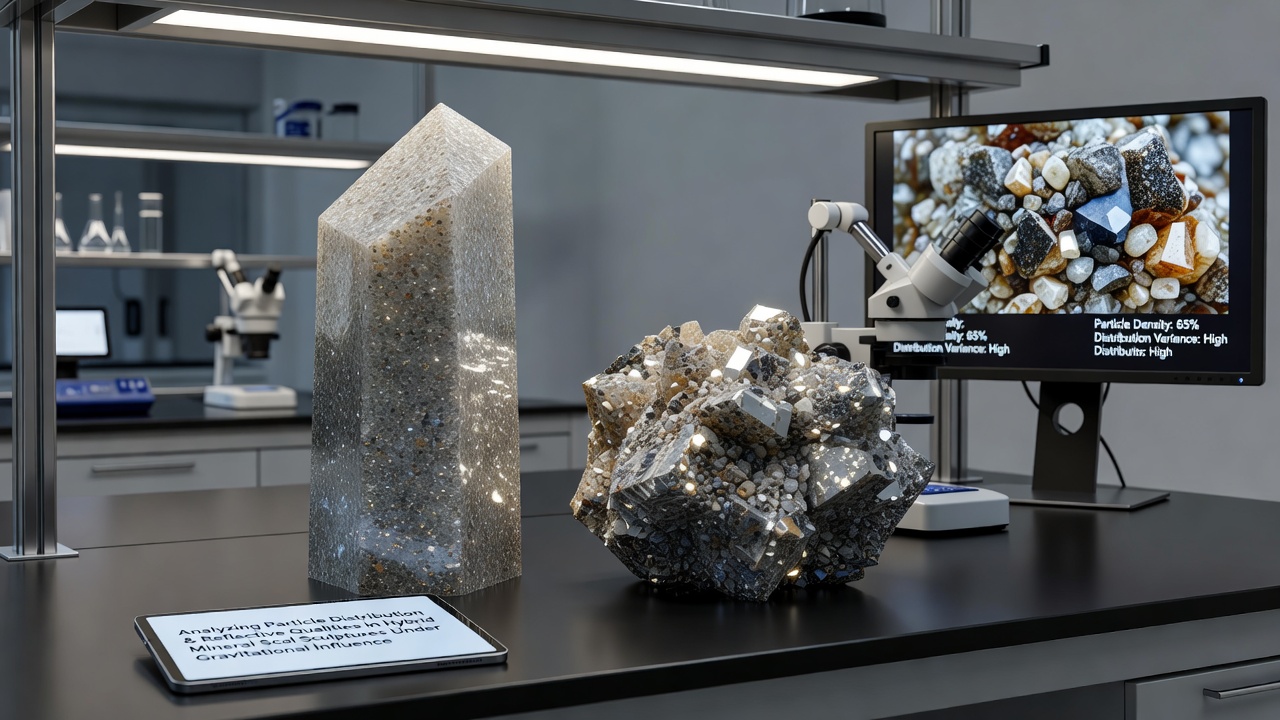
Spectrophotometers equipped with integrating spheres capture total reflectance values, while goniophotometers track angular dependence that reveals how particle orientation affects highlight sharpness. Researchers apply laser diffraction analysis to characterize size distributions before casting, then correlate those results with post-curing surface scans obtained via confocal microscopy. One study at a European materials institute demonstrated that sorting particles into narrow size fractions before mixing raised average reflectance by 12 percent compared with unsorted blends under identical 4000K illumination.
Case Examples from Institutional Collections
Installations at the National Gallery of Australia have incorporated hybrid mineral works where particle distribution maps were generated through X-ray microtomography before final placement, and curators adjusted lighting tracks to minimize unwanted glare zones. Similar documentation efforts at Canadian university galleries show that sculptures with stratified particle layers maintain stable reflective qualities across seasonal humidity fluctuations because the layered structure limits moisture-induced surface roughening. These records provide baseline data for predictive models that simulate how distribution changes over decades of exposure.
Lighting Variables and Environmental Interactions
Gallery humidity levels between 40 and 55 percent combined with temperature cycles of 18 to 24 degrees Celsius influence particle surface oxidation rates, which in turn modify reflectance spectra over time. LED fixtures with high color rendering indices above 90 preserve the intended chromatic balance of mineral pigments, whereas lower-index sources introduce metameric shifts that alter perceived brightness depending on particle composition. Engineers at lighting design firms have developed modular track systems that permit fine angle adjustments, and institutions report that recalibrating fixtures every 18 months maintains consistent visual impact across changing exhibition layouts.
Conclusion
Particle distribution analysis supplies sculptors and conservators with quantitative parameters for predicting reflective behavior under standardized gallery conditions, and continued data collection through 2026 supports refinement of both material formulation protocols and lighting specifications. Institutions that integrate these measurements into acquisition and maintenance workflows achieve more predictable visual outcomes across multiple viewing distances and angles.